Sunday, July 24, 2011

Preface

I have prepared this memoirs on the occasion of my 80th birthday on November 28, 1978, early enough before the time comes when I can no longer do it. It is so written in brief and easily understandable language so that in the simplicity of it’s form, it can easily be understood even by my grandchildren, relatives and friends, for them to know how I started life from scratch compared to the modern life the children are now enjoying. It covers a period from my childhood up to more than half a century of active public sevice both in the government and private sectors, to which with God’s help, I attribute the secret of long life.
This memoir also contains pictures to portray the important happenings in my life instead of long stories which oftentimes the reader only fails to read to the end. It also includes a few of the “Unforgettable Incidents” not only to entertain mistakes which sometimes are innocently committed since no one is perfect in this world.

--Dr. Nicolas S. Sevilla

Family Tree

Family Tree Circa 1978 (click to view actual size)

Resume of Service Record

  1. Was the recipient of the Provincial Scholarship of the Province of Rizal to study in the College of Veterinary Medicine, University of the Philippines. (1918-1923)
  2. Holder of the Degree of Doctor of Veterinry Medicine from the University of the Philippines, 1923.
  3. Obtained First Place in the Civil Service Examination for Veterinarian and Second Place in the Veterinary Board of Examination in 1923
  4. Thirty-nine years of continuous service in the Philippine Government, occupying various positions of responsibility:
    • Instructor, Zoology Department, College of Liberal Arts, U.P. June 14 to November 22, 1923.
    • Veterinarian, Bureau of Agriculture, November 23, 1923 to March 31, 1934. c.


Unforgettable Incidents

I spent “vacacion grande” in Dr. V. Buencamino’s Veterinary Clinic in Felix Huertes with Dr. Angel K. Gomez as attending Veterinary Surgeon. One morning, as I poured a basin of mercuric bichloride (1:20000), I was spotted by Dr. Buencamino and he told me, “Sevilla, you are going to destroy my pipings”, the time I recalled that bichloride solution could really corrode any metal from my theoretical knowledge which I learned from my Chemistry class. When I was back to college, the experiment I got from that clinic of Dr. Buencamino made me a new man with grades of 1 in the Clinics of the Veterinary College, U.P. 


Young veterinarians as usual are assigned in the field jumping from one province to another, from the most northern part of the Philippines to Mindanao waging Rinderpest campaign by quarantine and vaccination works. One day my vaccinating party was in a town of La Union with about 800 carabaos gathered waiting for vaccination. It so happened that one carabao dropped down immediately after vaccination. It was a terrible incident, a case of Anaphylaxis, but to explain to a hundred of farmers the theory of anaphylactic reaction to a susceptible animal would be just like talking Greek which could not be understood. What I did was to get a blood smear, stained it with ink drawn from a Parker pen (for I did not have any staining solution at that time). Of course what I could see are the tiny muscle fibers, and certainly I did not expect to see any organisms, so I called on the most educated and the most influential Tiniente del Barrio and showed him the tiny fibers calling it “anthrax”. The Barrio Lieutenant after peeping through the microscope shouted to his people “mga gagayem nakitak ni duang a mata ti microbio na natay ta nuang”. That relieved me a bit but during our lunch, I could not swallow the delicious foods prepared by the barrio folks for us. What lingered in my mind was that the owner of the carabao with bolo in his hand ready to hack me. Salamat at naawat ng Tiniente del Barrio. This accident reached the office of the Governor of La Union, relayed to the Secretary of Agriculture and the director of Animal Industry. I thought that was the end of me, but no. on the other hand, I was praised for what I had done to save the situation. 
 

Our 50th and 57th Years of Married Life

Our Golden Wedding was officiated by Fr. Benedicto in the Sacred Heart Church of Malabon with the principal sponsors Don Augusto A. Santos, Eng A.Tanabe, Mrs. C. Oreta, and Mrs. A.Garcia accompanied by all my grown-up sons and daughters and in-laws. It was a joyous affair with about 250 guests. Reception was held in the Fish Fun in Malabon.

Below is a picture of my bride whom I had married secretly on May 25, 1919, followed on June 19, 1921 in the Catholic Church of Pasig; then the Silver Wedding during the Japanese Occupation and finally the Golden Wedding on June 19, 1971. There can be no stronger ties than these four weddings we had every June 19.


It will be 57 years of happy marriage with 3 sons and 5 daughters, their wives and husbands, 36 grandchildren, and 10 great grandchildren as shown in the photo. It only shows how one man can help in exploding the population so that the people would not wonder if the Filipino people has increased to 40,000,000 in 1978.

In retrospect, the 60 years of love including the three years of engagement, includes the 57 years of happy married life. All adversities in life common to married couples were surmounted as the children grew up and ascended the steep ladder of education from elementary to college education to the extent of disposing off real estate properties just to push through in their careers.

But after all these hardships, one by one the children had left us to have their own homes and families to raise leaving us in a big house built for a big family where we found ourselves alone as if we were back to what it was 50 years ago. We always pray together to our Lord that this should not be the last cake from my 50th year bride; for on 1981 will be our 60th anniversary.

We are alone with an unmarried daughter living together with two dogs. Our life brighten with a ray of hope and happiness whenever the children are around for a visit, and when me and my wife meet our aging relatives on such special occasions like marriages, birthday parties, house blessings and funeral services of dead relatives and friends.

The old adage which I love to recollect have served in some way for my peace of mind and which I am sure would do the same to other people. Some are in Spanish, others in English and in the local dialect.


    Una vez me engeƱa, pierdo la confianza para siempre
    Un pajaro en la mano equivale sien pajaro volando
    Pag may isniuksok sa ding-ding, may titingalain --- meaning to save.
    if you do not like to lose a good friend, do not lend him any money ---“pagkat pag hindi makabayad ang iyong kaibigand ay magtatago o iiwasan ka pag ‘yong makakasalubong.”
    A rolling stone gathers no moss. If you are engaged in a profession, stick with it. 
    “No man is an island.” In my case, I could easily do my job with the help of my colleagues in the office and with my wife, relatives, and friends.  

The K of C Council No. 3951

I joined the Knights of Columbus almost 30 years ago. It is a civic-semi-religios organization with the good people of Navotas and Malabon as members, and where I had been elected to the position of Chancellor twice. I cannot forget the activities we had heartily enjoyed particularly the caroling before Christmas and the distribution of gifts like rice, “de lata” and candy to the poor.


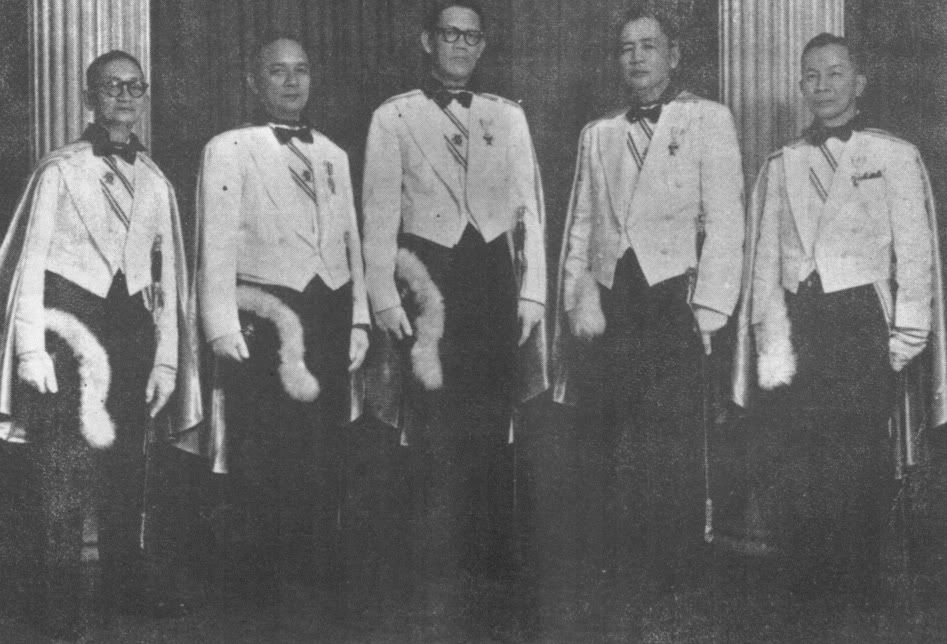
It also reminds me of my good and faithful companions in the Knight of Columbus, like S.K.A. Tanabe, Z.Roldan, M.Manapat, F.Santos, N.Jocson, and eleven others of this organization who had been helpful to me during my knighthood.


Recollection Of My Past Colleagues

  Going back to the barber shop story, there used to be five of us: Col. J. Espiritu, Dr. H.Sevilla, an M.D. and Jesus Sarmiento of American Veterans. We used to meet together in Edong’s Barber Shop on Sundays waiting our turn for haircuts. There were a lot of news, local and international, which had been the subject of our talks and commentaries. Now, I am alone with nobody to talk to except with our barber Edong for the three had gone to the Great Beyond.

This reminds me of similar happening when thirteen graduates belonging to the Class’23 from the College of Veterinary Medicine U.P., twelve had passed away leaving me as a lone survivor.
 

My one though is “where are they now?” who left me alone as if I am the “Last Leaf on the Tree”, a poem by Robert Burns.

With The Virginia Inc

 
People think that a veterinarian is mainly for the treatment of sick animals. This is a fact since this is the basic training in the curriculum of the U.P. College of Veterinary on Animal Nutrition, Animal Products Processing, Breeds, and Breeding. Luckily, however I had received a certificate for outstanding achievement on animal products preparation and now as Consultant of a feedmill, the Virginia, Inc. where the work is geared towards the meeting of two factors of economics and nutrition and where I feel as a partner of the animal owners themselves in safeguarding the good health and performance of their stock through proper nutrition, for a sub-standard feed quality would rebound to negative results. This is achieved through good feed formulations, quality control of ingredients and the finished products proven by trial feeding with experimental animals since the final judge are the animals that eat the feeds. This new assignment in a private company made me fully aware of the fact that the primary purpose of feeds is to support life for the proper performance of the body like good growth, reproduction, production of meat and eggs --- the only keynote of success in the feed milling operation.

Life After Retirement

On the evening of my retirement as Chief, Livestock Research on Nov 28, 1963, me and my entire family were treated in a downtown Chinese restaurant by about 150 colleagues in the Bureau. It was a joyous occasion but a painful separation after 39 years from my former co-employees. When my turn came to talk I could hardly express the words of appreciation after a plaque for outstanding achievement signed by the officials of the Bureau was awarded to me.

When Peping Rodriguez of Luzon Surety learned of my retirement, he asked me to manage the family piggery farm in Montalban. Other owners of piggeries followed suit and they became my retainers like the Mendoza’s in Sta. Maria, De Guzman’s in Had Pinugay and three other piggeries.

Four years later, on Feb 20, 1967, I was surprised when Don Augusto A. Santos of the Prudential Bank gave me the full time job to manage the Superior Feed Mills and Virginia Inc., where I still work up to the time of this Memoirs. In here, I also acquired some experience on the modern treatment of Thoroughbred horses owned by Don Augusto which are bred for breeding and propagation in his three stud farms in Maisan, Valenzuela, In Dadiangas, and Lipa City. I am so occupied that I have to give up my other assignments as Professional Lecturer in Comparative Nutrition (Animal Nutrition or Nutritive IV) in the Philippine Women’s University and on Animal Products Processing in the Araneta Foundation University.

With God’s help, I am still sound in body and soul in spite of my busy days on my present work as consultant in these two sister feedmills.

A Lone Delegate To The 8th International Congress On Animal Production, Hamburg, West Germany.

About 1000 delegates represented the different countries in Europe, Middle East, Africa, Japan, and Asean countries, including New Zealand and Australia. My paper on Philippine Animal Situation did not have the chance to be read, however it was published in the Official Report. It was the first time where I had heard the shortest report from each speaker which could be understood with the aid of earphones in different language, i.e., if you are English speaking, report in French is transmitted to you in English.

I had several funny incidents in Hamburg, like for example, at Frankfurt, I was questioned by German officers for leaving two bottles of native sweets inside the plane when every passenger was to vacate the plane for cleaning before proceeding to Hamburg. The sweets was intended for the Consul in Hamburg. When I ordered for “pigs’ feet” for a change, I though it was cooked ala-Filipino Style of “Paksiw na Pata” only to find out that it was only steamed on which you have to add half a dozen spices to suit your taste. In Paris airport, I made the mistake of going towards the opposite direction in the very long alley of the airport to the place of the plane which would take me to Rome and Cairo. However, the plane waited for me which cause the delay of the flight.

First Philippine Agricultural Mission to USDA

I was greatly surprised when in July 1946, I was told to join as member of the first Philippine Agricultural Mission to the United States with Prof. De Leon of the UPCA and Atty. C. Crucillo of the NEC. The mission is a counterpart of the American Agricultural Mission to the Philippines after the liberation. It was so glorifying for it is the dream of every Filipino to see America, as if it is like the golden sun’s rays which had pierced through the thick clouds of sufferings, doubts and apprehension after four years of deprivation under the Japanese Occupation.

There was no commercial boat then nor plane after the Liberation so our party with sixteen other pensionados and 1,400 returning American soldiers from Japan bombarded the USS Freedom. Upon reaching San Francisco, we were billeted in a hotel where we were shed-off with borrowed army clothes and shoes with the genuine “Americana” civilian attire. In USDA, Washington D.C., I was asked as to what I wanted for a study tour. As representative from the Department of Agriculture, I replied that I wanted to see animal production in the farms and ranches to marketing and processing of meat in the meat packing plants in Chicago and Kansas City. Experimental stations in Cornell, Wooster, Ohio, Missouri, Louisiana, Hudgins Ranch, and Las Cruces and King Ranch were included in my itinerary. It was in Pennsylvania where I was mistaken for a Chinese probably because of my eyes which my mother gave me, for after lunch in a small restaurant, I was handed a Chinese “paper” to read.

From Las Cruces in New Mexico, I was called back at Washington D.C., where I orally reported in a seminar held in the USDA on the animal situation after the devastation during the Japanese Occupation, and on my observation studies in the ranches and experiment stations I had visited.


It was in Hudgins Ranch, Louisiana where I saw the beautiful Brahman cattle, manner of transporting cattle by overland and overseas, the Sta. Gerthrudis cattle in Texas on a million acre pasture land, the Palomino horses and how they are managed and fed with Blue Grass. In Las Cruces are the Hereford, the poor man’s cattle they call it, that thrives only in Gramma, the only grass that could thrive in a semi-desert where cactus was the only available forage before.

After almost six months of observation studies, in late December of 1946, we crossed the continent back to San Francisco. While waiting for almost ten days for an army plane to Honolulu, I had also helped Dr. Austria in shipping by plane the 100,000 baby chicks which the US government had donated to the Philippines.

The white birds which later on abound in the poultry farms was the beginning of the poultry industry in our country.

In Honolulu, we were met by the USDA technical experts on poultry and dairy industry who showed us the Holstein cattle before and after treatment for liver flukes with amazing results after the treatment with Phenothyzine. It was in Hawaii where we enjoyed again the Filipino food like “Tinapa”, Sinangag, and Chocolate.

After ten years, the triumvirate, the three members of the First Philippine Agricultural Mission to the United States in 1946, met again in the UP College of Agriculture in Los Banos on the occasion of the Loyalty Day regularly celebrated every year, with Prof. De Leon, Director C. Crucillo, pf the NEC, and myself.

As The Chief Livestock Research Division


After the reorganization in 1955, the Animal Products Division was made a mere section of the Livestock Research Division which includes the supervision of the Stock Farms in Bongabong, Alabang, Baguio, and Milagors. This enabled me to visit these farms; but, the visit to Milagros is what I feared most because the plane lands on a ramp with it’s nose directed towards the cemetery of Masbate. In these four farms, forage production had been improved, and all experiments on feeds and feeding, animal nutrition were given emphasis, as well as improvement of the breeds and breeding especially on dairy cattle.

The Birth of a Meat Processing Industry

The big volume of Chinese hams imported yearly into the Philippines since the Spanish regime, prompted the government to look into the feasibility of a new industry on meat processing with emphasis on ham making and other meat products. A committee of three Youngberg, Fajardo, and Rotea were sent to China only to report that the Chinese method of ham making and other meat products cannot be applied here because hams are only made during the winter season. So, Dr. Rotea was sent to the Meat Packing Plants in Chicago and when he came back the Animal Products Division was created as an experimental pilot plant which later on was left to me to administer, Besides hams, experiments on bacon and different kinds of sausages, butter, and cheese were undertaken.

Meat processing was hitherto unknown before in the Philippines. Only “tapa” and native sausages are made from meat remaining unsold at the end of the day in the public markets.


What remains in my mind is: are the flourishing meat plants in the country today, the offshoot of that pilot plant?


The Starting Point of My Career

After my graduation from the College of Veterinary Medicine, U.P., in 1923, I was appointed instructor in the Zoology Department, College of Liberal Arts, U.P. for one semester; then as Assistant Veterinary in the erstwhile Bureau of Agriculture. My first field assignment was in Calumpit, covering Quinqua, now Plaridel and Pulilan, for the control of Rinderpost; then to San Miguel, Bulacan and later in the Office of the Provincial Veterinarian in Malolos. When the carabaos in Cagayan became infected with Blackleg, I was asked to proceed to Aparri, to put up a veterinary medical center in Barrio Caparaanan where animals were brought in for treatement. Blackleg is characterized by marked edematous swelling of the hind legs with pus and rotting muscle tissues inside so that holes had to be incised from top to bottom for irrigation with disinfecting solution placed on an elevated drum and rubber hose so that as the carabaos passed through the chute, they could be thoroughly cleaned and disinfected.


The rest of the field work was close surveillance on the progress of rinderpost, doing quarantine and vaccination works on the farmer’s carabao whenever there was any sign or danger of infection. This field work enabled me to serve and inspect practically all the provinces from Ilocos provinces and Cagayan Valley to down south as far as the Bicol provinces, and from Negros Occidental to Panay Island, using motorcycles with sidecars and horseback in places impossible by vehicles like the riverbeds and mountain trails in the Mountain Province. It is the most enjoyable work better than to be confined within the four walls in the Zoology class of the U.P. for I was able to see and deal with the animal raisers, barrio, municipal, and provincial officials. I cannot forget the hospitality of the barrio people where I had been in their preparations even fit for a VIP, and the dance with the beautiful barrio lass, the delicious “basing babae” and “tapoy” which could swoop you down to sleep if you take an overdose of that Ilocano delicacy. I had enjoyed this field service work from 1924 to 1930, covering a period of seven years to which I had vaccinated 300 to 500 carabaos in each vaccinating center in the Ilocos Provinces against Rinderpost with only one casualty due to Anaphylocis, a term hard to explain to the farmers. I could not swallow the delicious food “nilagang manok”, lechon, hard-boiled eggs prepared for us on that eventful day. Anaphylactic reaction could cause sudden death to an individual due to hypersusceptibility to protein substances and this is what happened to this carabao.


Probably when the people in the Central Office of the Bureau got tired of transferring me from province to province, I finally landed in the Veterinary Research, Laboratory at Pandacan, Manila for diagnostic works.


My Highschool and College Adventures


After my graduation at the age of 18 from Pasig High School, I bought home two important things dear to my life --- the High School Diploma and the “hand” of a sweet Pasiguena. I happened to board in a house just across the street where the beautiful Pasiguena lived who refused to go back to El Buenconsejo College when we became acquainted. But, after two years of engagement, the U.P. Board of Regents transferred the College of Veterinary Medicine from Padre Faura to Los Banos. Emilia, (the name of my sweetheart) did not want me to go. She thought Los Banos is far beyond the horizon and she advised me to transfer to Law. That was not materialized when I was told by Atty. Arsenio Santos, of the Provincial Board that I have to pay back the one year pension granted me by the Rizal Province to study Veterinary Medicine. The problem was settled through a secret marriage and when our parents discovered our secret marriage, we remarried at the Pasig Catholic Church on June 19, 1921. According to my relatives in Malabon, it was a test case to find out of a married college student could still pursue his studies. That was proven when in the results I got first place in the Civil Service and second place in the Board Examination for veterinarian in May 1923.

My Early Life

I was born in an obscure barrio of Catmon and grew up in Maysilo, Malabon, Rizal where I had spent my childhood. On the latter barrio (Maysilo), a place halfway between my father’s birthplace in Tinajeros and that of my mother’s in Malinta, Polo, Bulacan (now Valenzuela), where mother had spent her maidenhood later with Lola Tita on her seven-hectar land planted to sugar cane and fruit trees where, I was told, their courtship took place. My teacher was my mother who oftentimes had to hunt for my leaflet “caton” which I used to hide under the dry bamboo leaves to escape from the tiresome A, B, C lessons everyday. I still remember when she used to ask me to join her in her long rosary prayers every night in Spanish, for she had spent her school days in La Concordia and Beaterio College before her marriage. When I got tired reciting the long rosary, I had to move behind her still answering the prayers lying down.

Later, my Uncle Sario used to take me along proudly carrying his big dictionary to the nearby barrio school. They said I am a “saling-pusa” for there was no kinder similar to what we have now. My first and second grades were spent in the Tinajeros Barrio School and the rest up to the 7th grade in Hulong Duhat Malabon Elementary School some five kilometers from home crossing the dikes of fishponds to reach the school every schoolday.

Life then in barrio Maysilo was peaceful. The people lived a simple way of life with nobody I know had to work for a living but nobody was hungry, no hold-up, for the source of food was from the nearby river rich in marine products when water pollution was yet unknown. The cereals came from the nearby ricefields across the river. People helped each other whenever help is needed. Gone are those good old days when on the morning of Sunday some twenty barrio folks, young and old, sat around waiting their turn for haircut by a lone barber whose shop was under a mango tree with no chair to sit on but a tall box. I still remember when I could hear the murmuring sounds from the stomach of the lone barber if my turn happened to be the last for haircut.

After more than 50 years, I am now a total stranger in Barrio Maysilo for the old folks have already gone to the great beyond leaving only the younger generations probably the grandchildren of those whom I used to associate during my younger days. Even the houses have changed from the nipa to semi-concrete surrounded by stone walls so that one cannot even greet them. Luckily, I still have three cousins and their better-halves still remaining in the big lot of Lola Tita.